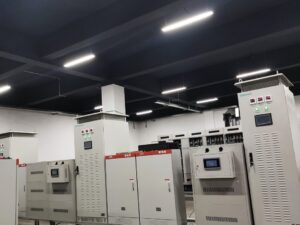
An oil and gas UPS specification should describe the protected loads, electrical interface, required autonomy, installation environment and maintenance path before it names a model. That information lets the project team compare a complete system proposal rather than a kVA figure alone. It also prevents an application label such as “oil and gas” from being mistaken for proof of hazardous-area certification: area classification and equipment location must be stated and checked separately.
For an industrial UPS RFQ, provide a load schedule and one-line diagram, define which loads are critical, state the required input and output arrangement, and document site conditions and project standards. Then ask suppliers to identify assumptions, options and exclusions in their proposal.
Define the load boundary before sizing the UPS
List what must stay powered
Identify each protected load, its normal and maximum demand, voltage, phase, frequency, power factor and starting or transient behavior where known. Separate essential control, instrumentation, communications and shutdown loads from equipment that can be shed. A total plant load is not a useful UPS sizing basis if only a subset requires conditioned backup power.
For each load group, record what happens when power is lost: does it need to continue operating, move to a defined safe state, or restart after the event? This helps the engineering team agree the UPS output boundary and whether loads should be grouped on one system or split across independent systems.
Provide usable electrical documents
Attach the latest single-line diagram, load list and available fault or protection information. Mark the UPS input source, bypass source, downstream distribution and any generator interface. If drawings are preliminary, identify the revision and list what remains undecided rather than presenting assumptions as approved design.
Specify the electrical arrangement, not just kVA
Match input and output to the distribution system
The CONSNANT industrial system page distinguishes CNI310 three-phase input/single-phase output (10–100 kVA) and CNI330 three-phase input/three-phase output (10–300 kVA). The CNI330 product page gives the product-specific starting point; project voltage, load distribution and the current configuration still need to be confirmed.
If the site expects an isolation transformer, voltage stabilization, harmonic mitigation or a particular rectifier arrangement, list it as a project requirement or option for the supplier to confirm. Do not assume every feature shown on a general system page is included in every rating or quotation.
State the operating and backup objective
Define the required battery autonomy at the specified load, the end-of-discharge condition, recharge expectation and any battery technology constraints. The supplier should return the battery assumptions and runtime basis with the proposal. Do not use battery capacity alone as a substitute for a runtime calculation.
Treat bypass and maintenance as a design question
Separate automatic bypass from a maintenance path
A static bypass is an electrical operating path used under defined conditions; a maintenance bypass is an arrangement intended to let the UPS power-conversion section be isolated while the load is supplied from an alternate source. The exact switching sequence and the conditions under which load continuity is maintained depend on the approved system design and site procedure.
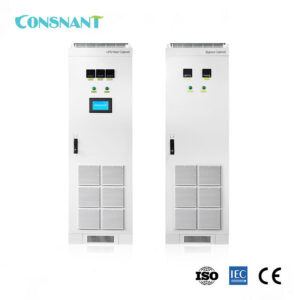
The CONSNANT system description presents a separate bypass feeder cabinet alongside the UPS main cabinet and battery cabinet. Ask whether the proposed cabinet is included, optional or project-configured; which source supplies the load in maintenance mode; what isolation points and interlocks are provided; and which components can be serviced without taking the protected load off its approved supply.
Document the actual installation environment
Describe the room, enclosure and area classification
Record indoor or outdoor location, ambient temperature range, humidity, dust, corrosive atmosphere, vibration, altitude, ventilation, available floor area, cable entry and access for maintenance. State the required enclosure protection and any project-specific environmental or seismic criteria for supplier review.
For oil and gas facilities, see the Oil & Gas solution page and provide hazardous-area classification, gas group, temperature class and applicable project standards where relevant. Also show where the UPS and batteries will be located relative to classified areas. An industrial UPS application or a project photograph does not establish that the equipment itself is certified for installation in a hazardous area.
Make monitoring and project acceptance explicit
Specify the signals and documents the plant needs
List required local indications, dry contacts, communication protocol and any interface to the plant DCS or SCADA. Confirm which alarms and measurements are available on the quoted configuration, and whether communication cards or other accessories are optional.
The RFQ should also state required submittals, inspection and test points, witness requirements, drawings, manuals, spare parts and documentation language. Ask the vendor to identify factory tests and site acceptance checks that are included in its offer; do not assume a particular test scope unless it is written into the project specification.
Use a concise RFQ checklist
Information to send with the enquiry
A practical first package can include:
- Protected load list with kW/kVA, phase, voltage and criticality
- Single-line diagram showing normal input, bypass source and downstream feeders
- Required autonomy and the load at which it must be achieved
- Site environment, enclosure location and hazardous-area classification
- Maintenance strategy, bypass expectations and isolation requirements
- Monitoring, DCS/SCADA interface, alarms and communication protocol
- Applicable project standards, inspection scope, submittals and approval milestones
Ask the supplier to return a compliance schedule that separates standard scope, optional items, deviations and open assumptions. That makes technical comparison more reliable than comparing headline capacity or a short product brochure alone.
How CONSNANT industrial UPS information fits the enquiry
Use model pages as a starting point, not a completed design
The CONSNANT industrial system overview describes a three-cabinet arrangement comprising a bypass feeder cabinet, UPS main control cabinet and battery cabinet, and lists oil and gas and petrochemical environments among its application areas. Its CNI310 and CNI330 product families differ in output phase configuration and capacity range, so the load schedule and distribution documents should determine which family is relevant.
The site also publishes a CNI310 oil and gas case describing three CNI310 20 kVA sets, each with a UPS host, bypass isolation voltage-stabilizing cabinet and battery cabinet. That is a published project reference, not a substitute for the current site’s electrical design, hazardous-area review or technical approval.
Conclusion
A useful oil and gas UPS RFQ makes the protected load, electrical topology, backup objective, environment, bypass path and acceptance scope unambiguous. If a detail is not known, mark it as an open item and ask bidders to state their assumptions. That gives the owner and EPC team a basis for comparing technically equivalent proposals and checking project fit before model selection.
FAQs
Does an industrial UPS automatically have hazardous-area approval?
No. The term industrial UPS or an oil and gas application reference does not establish a hazardous-area certification. State the area classification and required approvals in the project documents, then verify the exact equipment and installation location with the supplier and project authority.
Should an oil and gas project specify a separate bypass cabinet?
It should be evaluated when the project requires an external maintenance path, defined isolation points or distribution functions beyond the UPS cabinet. The final requirement depends on the system one-line, bypass source, load criticality, operating procedure and approved equipment configuration.