A project should evaluate a separate maintenance bypass cabinet when the maintenance plan requires the UPS power-conversion section to be isolated while critical loads remain supplied from an approved alternate source. It is not a universal add-on: the need depends on the one-line diagram, bypass source, load criticality, operating procedure, protection coordination and physical maintenance access.
The key procurement question is not simply whether the UPS has a bypass. Buyers should distinguish automatic static bypass from a manual maintenance path, then require the supplier to document the proposed operating modes, isolation boundaries and conditions for each mode.
Static bypass and maintenance bypass solve different problems
Automatic static bypass
A static bypass is an electronic path that can transfer the load from the inverter to the bypass supply under defined operating conditions, such as an overload or an inverter condition specified by the manufacturer. It is part of the UPS operating architecture; it does not by itself prove that the UPS can be safely isolated for hands-on maintenance.
Manual maintenance bypass
A maintenance bypass is a switching arrangement that supplies the load from an alternate source while allowing the UPS section to be isolated for service. In bypass operation the load is no longer being supplied through the inverter in the same way as normal double-conversion operation. The project should therefore assess the quality and availability of the bypass source and define what protection remains active.
When a separate cabinet is worth evaluating
Critical loads need a defined maintenance path
A separate cabinet deserves review when the protected loads are difficult to shut down, when the UPS is a shared system for multiple feeders, or when the owner wants switching and distribution functions outside the main UPS enclosure. A separate cabinet can also make the proposed system arrangement more visible in drawings and procurement schedules.
This does not mean maintenance can occur without risk or that every component can be replaced under every operating condition. The supplier and site authority must confirm which parts can be isolated, what the load sees during each transition, and which switching procedure is approved for the actual design.
The bypass source and electrical match are acceptable
The bypass supply must be defined alongside the UPS input and output: voltage, phase, frequency, neutral/grounding, source independence and protection. Ask the supplier to state the permitted synchronization or transfer conditions and the expected load behavior if bypass power is outside limits. Do not assume that a second cabinet creates a second independent source.
The cabinet’s physical and distribution functions are needed
A separate enclosure may be relevant when the project needs additional feeder ways, metering, isolation components or a particular cable-entry and service-access arrangement. The CONSNANT system page lists possible bypass-cabinet accessories such as isolation transformer, voltage regulator and multi-loop feeders; the buyer should identify required items and have each one confirmed as included, optional or excluded.
When it may not be the right default
Check for duplication and source limitations
A separate cabinet may add footprint, cables, devices and coordination work. If the UPS already includes the required maintenance path, if the load can be safely shut down for service, or if there is no suitable alternate bypass source, another cabinet may not improve the project’s protection objective. Compare the complete arrangement against the maintenance policy rather than treating an extra cabinet as automatically more reliable.
Questions to put in the RFQ
Request an operating-mode and isolation schedule
Ask the bidder to provide the following for the proposed UPS and bypass arrangement:
- A one-line diagram showing rectifier, inverter, static bypass, maintenance bypass, input sources and load feeders
- The normal, battery, automatic bypass and maintenance-bypass operating modes
- The source that supplies the load in each mode, including what happens if that source is unavailable or out of limits
- The isolation boundaries, interlocks, keying and any neutral/grounding constraints
- Which equipment can be serviced in each mode and which work still requires a planned outage
- Whether the cabinet, meters, feeder ways, transformers, regulators and protection devices are standard or optional
- Required tests, acceptance criteria, labels, operating instructions and responsibility for site procedures
Have the supplier identify assumptions and deviations in writing. The owner or EPC electrical authority should approve the one-line and operating procedure before installation or operation.
How CONSNANT describes its industrial bypass arrangement
Verify the final scope against the selected model
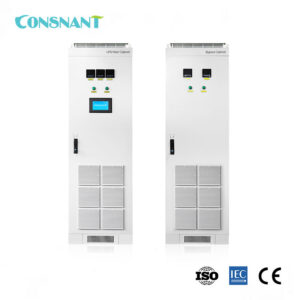
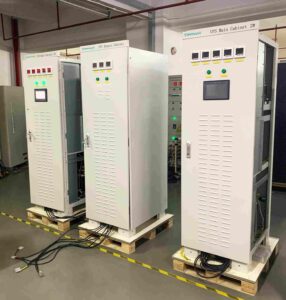
The CONSNANT industrial system overview depicts a bypass feeder cabinet, UPS main control cabinet and battery cabinet as the system arrangement. The page distinguishes automatic static bypass from manual maintenance bypass and describes an interlocked maintenance-bypass arrangement that can isolate the UPS main unit while the load is supplied from the bypass side. The page also lists several cabinet options, so the final bill of materials and wiring diagram should determine what is included.
The CNI330 product page describes a main UPS cabinet plus an independent bypass cabinet as its standard configuration. A published CNI310 oil and gas project reference describes each set as a CNI310 20 kVA UPS host, bypass isolation voltage-stabilizing cabinet and battery cabinet. These pages demonstrate relevant product and project configurations; they do not remove the need to confirm rating-specific design, transfer limits, isolation details and site approvals for a new project.
Conclusion
Specify a separate bypass cabinet when the project’s maintenance objective, alternate source and distribution design justify a dedicated external path. Make the supplier show the operating modes, isolation boundaries, source conditions, included accessories and test scope. A clear one-line and approved procedure matter more than a blanket claim that maintenance will never interrupt the load.
FAQs
Is static bypass the same as maintenance bypass?
No. Static bypass is an automatic electronic operating path under defined conditions. Maintenance bypass is a switching arrangement intended to let the UPS section be isolated while the load is supplied from an alternate source. A project should confirm the exact implementation and limits in its technical submittal.
Does a separate maintenance bypass cabinet provide battery backup?
Not by itself. Battery backup is provided by the UPS battery system in the specified operating mode. When the load is supplied from bypass, behavior depends on the bypass source and approved system design.