A factory does not need an industrial UPS simply because the equipment is installed on an industrial site. It needs a power system whose electrical architecture, environmental tolerance and maintenance arrangement match the loads that must remain protected.
That distinction matters because “industrial UPS” and “commercial UPS” are not complete specifications. A commercial high-frequency online UPS may be suitable for a clean electrical room serving servers, PLC networks or light automation. A project-engineered industrial UPS becomes more relevant when the site involves difficult power conditions, isolation requirements, high-impact loads, harsh surroundings or a maintenance philosophy built around long service life and replaceable assemblies.
For factory buyers, the useful question is therefore not which label sounds stronger. It is which design can meet the actual operating and failure conditions. The following seven comparisons turn that question into an engineering checklist.
Industrial UPS and commercial UPS are designed around different priorities
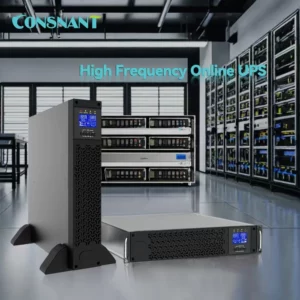
Both product families can use online double-conversion topology, so topology alone does not settle the choice. The difference is usually found in how the complete system is designed, configured and maintained.
A commercial online UPS prioritizes standardized deployment
Commercial high-frequency UPS systems commonly serve data rooms, communication rooms, financial systems and other controlled indoor loads. Tower and rack formats make them easier to fit into standard technical spaces. CONSNANT’s CNH330, for example, is a three-phase tower high-frequency double-conversion online UPS, while the CNH110R family uses a compact 19-inch rack-mount format.
This type of platform can also support some automation equipment. The deciding factor is not whether the load sits inside a factory, but whether its voltage, phase, inrush, waveform, environment and availability requirements fall within the published operating envelope.
An industrial UPS prioritizes project conditions and critical processes
An industrial UPS is more likely to be configured as part of a wider power system. The review may include transformers, bypass arrangements, DC voltage, battery chemistry, protective devices, communication with a DCS and cabinet construction.
CONSNANT positions the CNI310 and CNI330 families for applications such as power-plant control, petrochemical instruments, automated production lines, railway signals, tunnel monitoring and emergency safety systems. Those loads can carry consequences beyond the loss of office productivity, so the selection process must consider the protected process as well as the UPS rating.
| Comparison point | Commercial high-frequency UPS | Industrial UPS | Factory buyer should verify |
| Typical deployment | Standard tower or rack installation in a controlled room | Project-configured system for critical processes | Actual room and process conditions |
| Electrical architecture | Standard published input/output configurations | More project-specific phase, isolation and bypass options | Single-line diagram and grounding plan |
| Load review | IT, communication and defined automation loads | Control, instrumentation and process loads with site-specific behavior | kW, kVA, power factor and transients |
| Maintenance | Standard product service procedures | Plant isolation, bypass and long-term assembly support | Required energized state during service |
| Integration | Network monitoring and standard interfaces | DCS/plant monitoring and project alarm mapping | Protocols, contacts and commissioning scope |
Compare the incoming power conditions
Start with evidence from the site rather than a generic statement that the grid is “unstable.” Record normal voltage and frequency, the duration and depth of sags, surge exposure, harmonic distortion, generator behavior and any switching events created by large plant equipment.
Check the input window under full operating conditions
A wide input-voltage range can reduce unnecessary battery transfers, but the published range may include derating zones or other conditions. Ask the supplier to state usable output capacity across the expected input range, not only the absolute voltage limits.
Also confirm how the rectifier starts and how much input current it demands. This matters when the UPS shares a feeder or generator with motors, drives and process equipment.
Treat the generator and bypass as part of the system
If backup generation is present, verify frequency tolerance, rectifier ramp behavior, charger demand and the intended sequence between mains, battery, generator and bypass. A UPS that works correctly on utility power can still create an integration problem if the generator or bypass source falls outside the required conditions.
Match the UPS to the load, not only the kVA total
Two factories with the same aggregate kVA can require different UPS designs. A server room, a PLC and instrumentation network, a group of variable-frequency drives and an emergency trip system do not behave in the same way.
Separate continuous load from transient demand
Build the load schedule in both kW and kVA. Record power factor, starting or inrush current, non-linear behavior, phase imbalance and any load that may regenerate energy toward the UPS. The usable UPS rating must satisfy the real load profile after applicable derating.
Do not add every motor in the plant to the UPS by default. Define the protected boundary first: control power, instrumentation, communications, actuators, essential computers and any equipment needed for a controlled shutdown.
Confirm phase architecture early
The CNI310 is a three-phase-input, single-phase-output industrial online UPS, while the CNI330 is a three-phase-input, three-phase-output family. CONSNANT’s CNH330 commercial high-frequency family is also three-phase input and three-phase output. These are different architectures, not interchangeable capacity options.
The RFQ should therefore state input and output voltage, phase, frequency and grounding arrangement before a product family is shortlisted.
Decide whether galvanic isolation is required
Isolation should be tied to a defined engineering objective. Possible objectives include separating source and load grounding arrangements, managing common-mode disturbances or meeting the requirements of a particular process power architecture.
CONSNANT’s CNI310 information describes built-in input and output isolation transformers. The CNI330 information describes input, output and bypass transformers for galvanic isolation. That is a material architectural difference to compare with a standard high-frequency UPS proposal.
Do not request transformers only because they sound more industrial. They affect footprint, weight, heat rejection, efficiency, installation and maintenance. The specification should state why isolation is needed and where it belongs in the power path.
Evaluate the installation environment
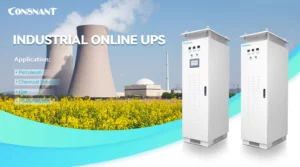
“Installed indoors” does not automatically mean “clean and controlled.” Dust, conductive particles, moisture, corrosive vapors, heat, vibration, pests and restricted ventilation can all change the suitable cabinet and cooling design.
Record conditions at the proposed UPS location
Provide minimum and maximum temperature, humidity, altitude, dust or corrosive exposure, ventilation, room cooling, floor loading and access clearances. Also identify whether maintenance staff can safely reach the front, rear and sides of the equipment.
The CNI310 information lists an IP42 cabinet and an operating range of 0–40°C with non-condensing humidity up to 95%. Those values should be checked against the actual room; the word “industrial” does not remove the need to verify the published limits.
Do not confuse indoor industrial cabinets with outdoor protection
If the equipment will be exposed to rain, solar heat or uncontrolled outdoor air, an indoor industrial UPS cabinet should not be assumed suitable. Outdoor enclosure protection and thermal management require a separate review.
Compare bypass, maintainability and service strategy
The cost of a factory outage often depends on how the system can be isolated, repaired and returned to service. Buyers should therefore compare maintenance paths, not just conversion efficiency and front-panel features.
Define what must remain energized during maintenance
Ask whether the proposal includes a static bypass, a maintenance bypass and safe isolation points. Confirm what happens during a rectifier, inverter, control, fan or battery fault and which components can be replaced without shutting down the protected process.
The CNI330 product information lists a digitally controlled static switch and a static bypass designed for overload capability. The final project still needs a documented operating sequence and site-specific isolation arrangement.
Compare long-term support at assembly level
Request a recommended spare-parts list, component replacement intervals, event-log access, diagnostic support and the expected procedure for replacing fans, capacitors, control boards and power assemblies. A design intended for a long-lived process plant should be evaluated over its maintenance horizon, not only at purchase.
Specify monitoring and plant integration
A UPS alarm has limited value if it remains only on the local display. Define which statuses and events must reach the control room, building-management system or remote service team.
CONSNANT’s CNI310 information states support for RS485/Modbus communication and DCS integration. CNI330 information lists intelligent detection and monitoring, a large-screen LCD and storage for 256 events. Buyers should still confirm the exact protocol, register map, alarm contacts, cybersecurity boundary and responsibility for commissioning.
Useful points can include input and output status, load level, battery condition, bypass state, active alarms and event history. The required list should be agreed before purchase so that the UPS is not treated as an isolated cabinet after installation.
Compare customization without creating an unmaintainable one-off system
Industrial projects often need configuration choices that are not captured by one catalog code. CONSNANT states that CNI330 can be configured for project requirements including input and output voltage, phase, frequency, battery voltage, charging current and cabinet protection level.
Customization should solve a documented constraint. Every deviation should be reflected in approved drawings, settings, spare parts, manuals, test procedures and the final bill of materials. Otherwise, a technically workable special design can become difficult to support years later.
Battery chemistry is another system choice. CONSNANT lists lead-acid, nickel-cadmium and lithium compatibility for its industrial UPS families, but compatibility does not replace battery-system engineering. The charger, DC voltage, protection, autonomy target, temperature and maintenance capability must be reviewed together.
When can a commercial high-frequency UPS be the better fit?
A commercial high-frequency online UPS can be a sensible factory choice when the protected load is well defined, the equipment room is controlled, standard voltage and phase are available, isolation is not required, and the published overload, bypass, battery and monitoring functions meet the operating plan.
This may apply to an IT room, network cabinet, quality-control laboratory or selected automation loads. CONSNANT’s high-frequency online UPS range includes tower and rack formats for these types of compact deployments.
Choosing a larger industrial cabinet where the project does not need its architecture can add footprint, installation work and maintenance complexity without improving the actual protection objective.
When should a factory move toward an industrial UPS?
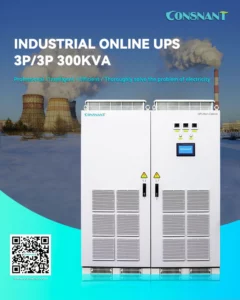
IMG.CONSNANT CNI330 300kVA Industrial Online UPS.jpg | Alt: CONSNANT 300 kVA three-phase industrial online UPS cabinet
An industrial UPS should enter the shortlist when the project requires a defined isolation arrangement, unusual input or output configuration, strong coordination with bypass and plant distribution, compatibility with site-specific batteries, exposure to difficult environmental conditions, or maintainability aligned with a critical process.
CONSNANT’s industrial online UPS range provides the broader product direction. The CNI310 three-phase-input/single-phase-output option can be reviewed for single-phase critical control loads, while the CNI330 three-phase-output range addresses larger three-phase industrial systems. For standardized tower or rack deployments, compare the high-frequency online UPS range.
The correct family should be selected from the load schedule, single-line diagram, environmental data and failure-response plan, not from the application label alone.
Factory UPS comparison checklist for an RFQ
Before requesting a quotation, provide:
- the protected equipment list and operating consequence of losing each load;
- measured kW, kVA, power factor, inrush and non-linear load information;
- input and output voltage, phase, frequency and grounding arrangement;
- utility disturbance records and generator details;
- required isolation, bypass and maintenance arrangement;
- temperature, humidity, altitude, dust, corrosion and ventilation conditions;
- battery chemistry, DC voltage, autonomy and recharge requirements;
- communication protocol, dry-contact and event-record needs;
- redundancy target and acceptable behavior after defined failures;
- access, footprint, floor-loading and cable-entry constraints;
- required documentation, factory tests, site tests, training and spare parts.
This information lets suppliers compare architectures against the same operating requirement. It also helps the buyer distinguish a genuinely suitable industrial design from a proposal that simply carries an industrial label.
Conclusion
The practical difference between an industrial UPS and a commercial UPS is not captured by frequency technology, cabinet color or kVA alone. Factory buyers need to compare source conditions, load behavior, phase architecture, isolation, environment, bypass, maintenance, monitoring and justified customization.
A commercial high-frequency online UPS may be the efficient choice for a controlled room and a standard critical load. A CNI industrial UPS becomes more relevant when the protected process requires isolation, project-specific electrical configuration, difficult-site adaptation or deeper integration with plant operations.
Start with the process and failure objective, then ask the supplier to demonstrate how the proposed architecture meets them.
FAQs
Is an industrial UPS always better than a commercial UPS?
No. It is better only when its architecture and configuration answer requirements that the commercial UPS cannot meet efficiently. For a standard load in a controlled room, a commercial high-frequency online UPS may be sufficient.
Can a commercial UPS be used in a factory?
Yes, if the load, electrical supply, environment, bypass, battery and maintenance requirements remain within the product’s verified limits. The factory location alone does not determine the UPS category.
Does an industrial UPS always include isolation transformers?
No universal assumption should be made from the category name. Check the actual product architecture. CONSNANT’s CNI310 information describes input and output isolation transformers, while CNI330 information describes input, output and bypass transformers.
What information is most important when comparing factory UPS proposals?
Start with the protected load schedule, input and output architecture, power-quality data, environmental conditions, bypass and isolation plan, battery autonomy, monitoring interface and maintenance requirements.
Which CONSNANT families should a factory compare?
For project-engineered industrial requirements, review CNI310 or CNI330 according to phase and capacity needs. For standardized high-frequency tower or rack applications in controlled spaces, review the CNH product families and confirm that their published operating limits match the site.