Factories often compare UPS systems by capacity first. That is understandable, but it can hide a more basic question: does the protected load need single-phase output or three-phase output? A three-phase input UPS can feed either architecture, and the right choice depends on the load boundary, downstream distribution and failure plan.
For a practical comparison, this guide focuses on CONSNANT’s CNI310 three-phase-input/single-phase-output industrial online UPS and CNI330 three-phase-input/three-phase-output industrial online UPS in the 10–40 kVA class. The comparison is about electrical architecture, not a claim that one family is universally better.
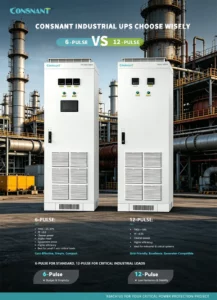
Start with the output architecture, not the product name
The input side of both families can connect to a three-phase supply. The key difference is the inverter output.
CNI310 is a three-phase-input, single-phase-output UPS
CNI310 is intended for projects where the available distribution is three-phase but the protected control, instrumentation or IT loads are single-phase. The 10–40 kVA product information lists three-phase 380/400/415 Vac input and single-phase 220–244 Vac inverter output.
This arrangement can be useful when the critical load boundary contains control panels, PLC-related equipment, instrumentation, communication equipment or other phase-neutral loads. It avoids selecting a three-phase output architecture when the protected equipment does not require one.
CNI330 is a three-phase-input, three-phase-output UPS
CNI330 is intended for protected loads that need a three-phase output architecture. In a factory, that may include three-phase distribution boards, process control systems or equipment whose input design and load balance are specified across three phases.
The CNI330 10–40 kVA product page describes a three-phase industrial online UPS family. The final proposal still needs to confirm the exact input and output voltage, frequency, neutral arrangement and bypass design for the project.
Compare the protected load boundary
The same factory can need both architectures in different areas. A control room may use single-phase output while a process distribution board requires three-phase output. The first step is therefore to define which loads must remain energized during a utility disturbance.
List loads by phase and operating consequence
Create a load schedule that identifies each device, its input phase, rated kW and kVA, power factor, inrush behavior and consequence of interruption. Mark the loads needed for controlled shutdown separately from those that can stop safely.
Do not place every motor or production machine behind the UPS by default. A smaller, clearly defined critical-load boundary is easier to size, protect and maintain than an oversized system built from an uncertain load list.
Check whether the load is actually phase-dependent
Single-phase loads are not automatically low importance, and three-phase loads are not automatically better protected by a three-phase UPS. The deciding question is how the equipment is wired and what the plant distribution requires.
If the downstream panel, control transformer or equipment manual specifies phase-neutral input, CNI310 may be the relevant architecture. If the equipment requires three-phase input and balanced distribution, CNI330 should be evaluated.
Match the UPS to the factory distribution
The UPS output is only one part of the electrical path. Buyers should compare it with the single-line diagram, downstream breakers, bypass source and grounding plan.
Verify voltage, frequency and neutral arrangements
The RFQ should state nominal input and output voltage, frequency, phase sequence, neutral requirements and grounding arrangement. These details should be confirmed before the supplier recommends a model or transformer configuration.
For CNI310, verify how the single-phase output is routed to the critical panel and how the bypass input is arranged. For CNI330, verify phase sequence, phase loading, bypass compatibility and the behavior of the protected three-phase distribution during transfer.
Review bypass and isolation as part of the system
Isolation is an engineering decision, not a synonym for “industrial.” CNI310 product information describes input and output isolation transformers. CNI330 project information can include input, output and bypass transformer arrangements. Buyers should state why isolation is required, where it belongs and what maintenance state must remain energized.
Compare load behavior, not only kVA
Two UPS systems with the same nominal kVA can behave differently when connected to a factory load.
Record inrush, non-linear loads and phase imbalance
The load schedule should include motor contactors, switched-mode power supplies, variable-frequency drives, rectifier loads and any equipment that may regenerate energy. Record starting current and transient demand separately from steady-state consumption.
CNI330 may be the more natural starting point when the protected distribution is three-phase, but its selection still depends on the actual load profile and allowable imbalance. CNI310 may be suitable for a single-phase critical boundary, but it still needs an appropriate power-factor and inrush review.
Allow for growth without hiding an oversized design
Reserve capacity for documented load growth, temperature effects and transient demand. State the reserve assumption in the RFQ so suppliers compare proposals on the same basis. Do not use a large UPS simply to avoid preparing a load schedule.
Consider installation and maintenance conditions
Industrial designation does not remove the need to verify the room and service arrangement.
Check cabinet, cooling and access constraints
Record temperature, humidity, altitude, dust, corrosive exposure, ventilation, floor loading and access clearances. Confirm that technicians can reach the required isolation points and replace serviceable assemblies safely.
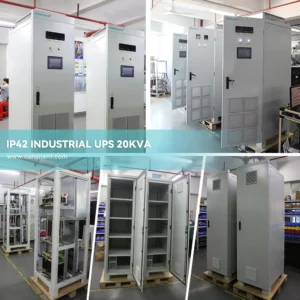
The CNI310 information lists an IP42 cabinet and an operating range of 0–40°C with non-condensing humidity up to 95%. These published limits must be checked against the actual installation room. CNI330 proposals should likewise state the selected cabinet protection and cooling arrangement instead of relying on the word “industrial.”
Define what happens during maintenance
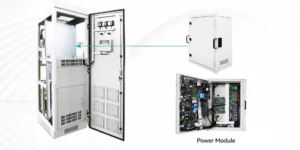
Ask whether the proposal includes static bypass, maintenance bypass and safe isolation points. Confirm which loads remain energized during rectifier, inverter, control, fan or battery service, and how the system returns to normal operation.
For either family, the maintenance sequence should be documented in the single-line diagram, operating procedure and commissioning scope. A cabinet that fits the room but cannot be safely isolated is not a complete factory UPS solution.
Connect monitoring to the plant control strategy
A UPS should not become an isolated cabinet after installation. Define which statuses and alarms need to reach the control room, DCS, building-management system or remote service team.
CNI310 information describes RS485/Modbus communication and DCS integration. For CNI330, confirm the exact communication protocol, register map, dry contacts, event records and commissioning responsibility. Useful points may include input and output status, load level, battery condition, bypass state, active alarms and event history.
Use a simple decision path for CNI310 and CNI330
Use the following sequence before requesting a quotation:
- Is the protected output distribution single-phase or three-phase?
- Does the equipment manual specify phase-neutral or three-phase input?
- What voltage, frequency, neutral and grounding arrangement are required?
- What is the measured kW, kVA, power factor, inrush and phase imbalance?
- Is galvanic isolation required for a documented engineering reason?
- What bypass and maintenance state must remain energized?
- What temperature, humidity, dust, corrosion and access conditions apply?
- Which alarms, protocols and event records must reach the plant control system?
If the protected boundary is single-phase after a three-phase service entrance, start the review with CNI310. If the protected distribution and load equipment require three-phase output, start with CNI330. The supplier should then confirm capacity, bypass, battery and cabinet configuration against the project documents.
Conclusion
CNI310 and CNI330 should not be treated as two versions of the same UPS with different labels. Their main distinction is the output architecture: CNI310 supplies a single-phase critical boundary from a three-phase input, while CNI330 supplies a three-phase critical distribution.
The correct selection comes from the load schedule, single-line diagram, phase requirements, isolation objective, environmental data and maintenance plan. Start with the protected equipment and downstream distribution, then review CONSNANT’s industrial online UPS range and ask how the proposed CNI310 or CNI330 configuration meets those conditions.
FAQs
Is CNI330 always better because it has three-phase output?
No. Three-phase output is useful only when the protected distribution or equipment requires it. A single-phase critical boundary may be better matched by CNI310.
Can CNI310 protect a factory control room?
It can be evaluated when the protected control-room loads use single-phase output and their voltage, power, inrush, battery and environmental requirements fit the selected configuration.
Can CNI330 supply single-phase loads?
Do not assume that from the product family name. Confirm the approved output architecture, downstream distribution and load connection method in the project design.
What should a factory send with an RFQ?
Send the load schedule, single-line diagram, input and output requirements, grounding plan, power-quality records, environmental conditions, battery autonomy, bypass and maintenance requirements, monitoring interfaces and required tests.
Which capacity should the factory choose?
Capacity should be calculated from the measured critical load, power factor, inrush, derating and documented growth reserve. The 10–40 kVA CNI310 and CNI330 pages provide a comparison basis, not a substitute for project sizing.