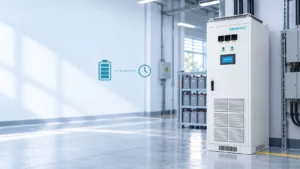
When a factory asks for “four hours of UPS backup,” that request is not yet a battery specification. The required battery capacity depends on the protected load, the UPS conversion efficiency, the usable depth of discharge, the battery’s end-of-life condition, temperature and the way the site will recover after a utility failure.
For an industrial UPS project, the practical question is not simply how many ampere-hours the battery has. It is whether the complete UPS and battery system can keep the defined critical load running for the required time under the site’s real operating conditions.
Start with the load schedule, not the battery label
Before sizing a battery bank, freeze the loads that must remain energized. Separate continuous loads from equipment that starts intermittently, and identify motors, transformers, heaters, drives and other devices with high starting or transient demand.
Record both watts and VA where possible. A UPS may be rated in kVA, while the battery ultimately supplies real power through the inverter. Power factor, nonlinear current and future load growth can all change the DC energy required from the battery.
For single-phase control loads such as PLC cabinets, monitoring terminals or laboratory instruments, review the CNI310 three-phase-input/single-phase-output industrial UPS. For a three-phase production or process load, the CNI330 three-phase-output family may be more appropriate. The output phase and load schedule should be confirmed before a battery quotation is prepared. For three-phase production or process loads, compare the CNI330 three-phase-input/three-phase-output industrial UPS against the load schedule.
Define what the backup time must cover
Backup time should be tied to a recovery scenario. A short autonomy period may cover the time needed for a generator to start and stabilize. A remote or unmanned site may require a longer period until utility restoration or field service. These are different design cases even when the normal load is identical.
State whether the requested runtime applies at the present load or the future design load, and whether it must be met at the beginning or end of battery life. Also state the minimum voltage and shutdown conditions accepted by the protected equipment.
Use a first pass energy calculation carefully
A useful preliminary relationship is: Required battery energy ≈ Load power × Backup time ÷ (UPS efficiency × usable discharge fraction).
This is only a screening calculation. The final battery bank must be checked against the selected UPS DC bus voltage, inverter efficiency curve, battery discharge characteristics, allowable end voltage, temperature and aging assumptions. A battery bank that looks adequate from its nominal Ah value may not deliver the same usable energy at a high discharge rate or at the end of its service life.
Select the UPS and battery as one system
The UPS model determines the DC voltage range, charging method, allowable battery strings and communication options. The battery choice then affects cabinet footprint, charging current, ventilation, maintenance and replacement planning.
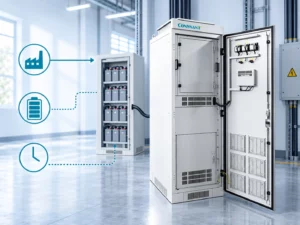
The Industrial UPS System Solution describes a complete architecture built around the UPS main control cabinet, bypass feeder cabinet and matched battery cabinet. Its CNI310 range covers three-phase input and single-phase output applications from 10–100 kVA, while CNI330 covers three-phase input and three-phase output applications from 10–300 kVA. These ranges should be treated as starting points for engineering review rather than automatic selections.
Check temperature, aging and installation conditions
Battery performance is affected by ambient temperature, ventilation, installation position and maintenance access. The design should identify the normal and maximum temperature, whether the battery room is conditioned, and whether the battery cabinet shares a room with heat-generating UPS equipment.
Do not size only for a new battery at room temperature. Ask the supplier to state the design assumptions used for temperature correction, usable discharge and end-of-life capacity. This makes quotations comparable and reduces the risk that two suppliers interpret “four hours” differently.
Confirm monitoring and maintenance requirements
Long-backup systems need more than a large battery cabinet. The project specification should define battery voltage and current monitoring, alarm contacts, communication protocol, inspection frequency and the records required for capacity testing.
The Industrial UPS System Solution page also describes communication options such as RS232/RS485, Modbus and optional remote monitoring interfaces. Whether these functions are required depends on the factory control system and the owner’s maintenance plan, so they should be confirmed in the RFQ.
What to include in an industrial UPS battery RFQ
- Critical load in kW and kVA, power factor and load growth allowance
- Required backup time and the recovery scenario after a power failure
- UPS input/output voltage, phase and frequency
- Generator or alternate-source information, if applicable
- Battery technology, design life and end-of-life runtime requirement
- Ambient temperature, altitude, ventilation and installation location
- DC bus voltage, battery strings and charging current
- Monitoring, alarm and communication requirements
- Factory acceptance tests and the runtime test method
Conclusion
Industrial UPS battery sizing is a system-design task. Start with the critical load and outage scenario, convert the runtime requirement into usable energy, then verify the result against the UPS DC bus, battery discharge data, temperature and end-of-life assumptions.
FAQs
Can I calculate UPS backup time from battery Ah alone?
No. Ah must be interpreted together with DC voltage, load power, UPS efficiency, discharge limits, temperature and battery age.
Should runtime be guaranteed at the beginning or end of battery life?
For a critical industrial process, the RFQ should state the required runtime condition explicitly. If the requirement applies at end of life, the initial battery capacity and replacement plan may be different.
Is a longer backup time always better?
Not necessarily. A longer runtime increases battery quantity, footprint, charging demand and maintenance requirements. The target should match the actual recovery scenario.